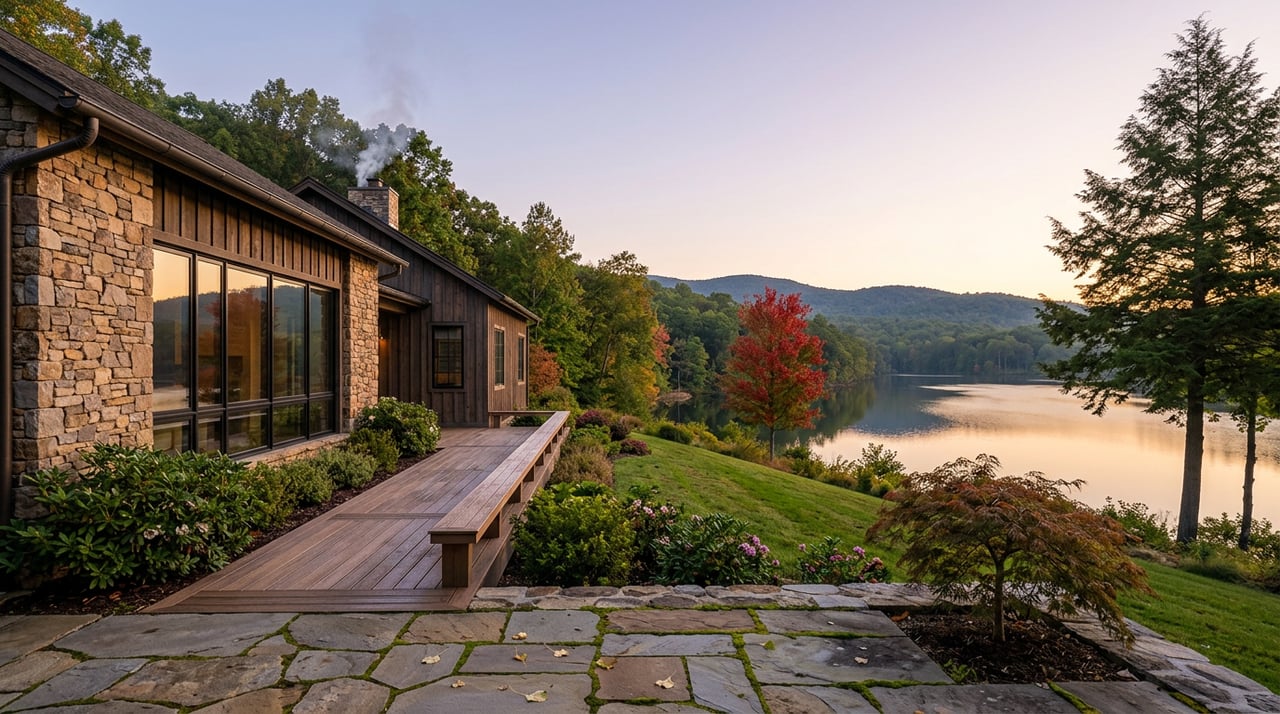
Walk down to a dock on Lake Blue Ridge this week and you might find your kayak sitting on wet clay instead of water. The shoreline that was lapping at the bottom step of the ladder in July is now ten or fifteen feet away, exposing rocks and roots that spent the summer submerged. If you're new to the lake, this looks like a problem. If you've been here more than one autumn, you already know what it is: the Tennessee Valley Authority just started its annual drawdown, and the lake is following its usual September pattern.
The confusion is understandable. Nobody hands new lake owners a manual. So here's the part that actually matters, the part that separates "this is normal" from "something's wrong."
The Drop Has a Schedule, Not a Cause
Lake Blue Ridge is a 3,300-acre TVA reservoir on the Toccoa River, built when Blue Ridge Dam was completed in 1930. It was never designed to sit at one level year-round. TVA holds the lake near its highest recreation pool through the summer, then starts releasing water in September to open up flood storage capacity before winter rains arrive. The lake typically swings about 20 to 22 feet between that summer high and its winter low, refilling gradually as spring rain returns.
That is a wide swing for a lake this size, and it is by design. The empty space TVA creates below the summer waterline is what absorbs a wet December or a soggy February without flooding docks, roads, and low-lying land downstream. The lake looking smaller in October is the lake doing its actual job.
One Foot at Blue Ridge Is Not a Small Number
If you follow TVA's public updates during drawdown season, you'll sometimes see releases described in feet, and Blue Ridge's number is often the smallest on the list. That can read as reassuring. It isn't quite the full picture.
Blue Ridge sits on a drainage area of roughly 200 square miles. Compare that to Douglas Lake in Tennessee, part of the same reservoir system, with a drainage area around 4,000 square miles. TVA officials have described pulling twenty times more water out of Douglas than out of Blue Ridge during a typical release, while the effect on each lake ends up being about the same in proportion. A release of a little over two feet at Douglas and about one foot at Blue Ridge are treated as roughly equivalent moves for two very differently sized reservoirs. TVA manages ten major tributary reservoirs this way, including Blue Ridge, Chatuge, Cherokee, Douglas, Fontana, Nottely, Hiwassee, Norris, South Holston, and Watauga, and no single lake is asked to carry the whole system's flood control burden alone.
The takeaway for anyone watching their own shoreline: a modest number next to Blue Ridge's name doesn't mean the lake is being spared. It means the system is small enough that a foot here does the same work a couple of feet does somewhere bigger.
The Fall Everyone Actually Remembers
If you've lived here long enough to recall a year when the lake seemed to disappear entirely, mud flats stretching out where boats used to idle, that wasn't a routine drawdown. In fall 2022, TVA needed to inspect and repair the dam's intake tower, which required pulling the lake down more than 60 feet, well beyond the normal seasonal range, and holding it there for roughly six months while every boat ramp on the lake sat high and dry. TVA described that project as likely the last time such an extended, deep drawdown would be needed.
That distinction matters because the two events get conflated in casual conversation. A 20-foot annual dip and a 60-foot maintenance drawdown are not the same phenomenon, and mixing them up is how rumors start that the lake is in trouble every time the water drops. What's happening on Lake Blue Ridge this month is the ordinary version. Nothing about this September points toward a repeat of 2022.
What Changes at the Ramps This Season
The practical effects show up first at the access points, and they don't hit every ramp the same way.
- Lake Blue Ridge Marina, the full-service ramp near town with fuel, a store, and the Boat Dock Bar and Grill, sits in the deepest channel on the lake and typically stays usable longest as levels fall.
- Lakewood Landing, off Old Highway 76 in Morganton, is another deep-water option that tends to hold up well into the drawdown, at a modest per-vehicle launch fee.
- Morganton Point, the only developed campground on the lake with a swimming beach and summer lifeguards, sees its boat launch get shallower as the season progresses, though the campground itself runs into October depending on weather.
- Dry Branch, reached by a gravel road off Highway 515, is the shallowest of the public ramps and is usually the first to become impractical for anything but a kayak or a small jon boat once the lake starts to fall.
If a fixed dock is part of your daily routine, this is the stretch where it starts to show its limits. Floating docks with enough gangway length ride the falling water down and keep working. Fixed docks built for summer depth can end up sitting above dry ground by December, which is exactly why plenty of longtime lake owners plan shoreline maintenance for this window rather than fighting it.
The Trail Sees It Before the Boaters Do
Head out to the Aska Adventure Area this month and the drawdown shows up on land before most boaters even notice it on the water. The 17-mile Aska Trail System, with trailheads at Deep Gap, Stanley Gap, Shady Falls Road, and Forest Road 711 off Campbell Camp Road, runs through mature hardwoods and stands of mountain laurel before several sections descend to the lake's shoreline. Hikers who walk those lower stretches in October will see exposed rock and lakebed that was underwater all summer, weeks before the change is obvious from a boat.
It's one more sign that this is the rhythm of the place rather than a departure from it. The same week the lake starts pulling back, downtown just wrapped the Blue Ridge Blues and BBQ Festival on September 19, and the Blue Ridge Scenic Railway shifted into its fall schedule with more frequent runs and open-air cars along the Toccoa River. The lake dropping, the leaves starting to turn, the railway adding cars, the festival calendar filling in: it's all the same seasonal clock, just told through a different part of town.
The Pattern Holds
None of this requires action from most lake residents beyond noticing it. Docks get adjusted, not replaced. Ramps get chosen with the season in mind, not avoided. Trails get hiked while the shoreline is exposed instead of hidden. The lake isn't failing anyone in September. It's following its usual fall pattern, unlike the exceptional 2022 drawdown, which had a name and a reason attached to it that had nothing to do with a normal fall.
If you're weighing what a property on or near Lake Blue Ridge is actually like to live with across all four seasons, not just the postcard version from July, that's a conversation worth having before you assume anything about dock access, shoreline behavior, or seasonal rhythm based on a single visit. The team at Kara Conrey spends enough time on this lake in every season to walk you through what a specific stretch of shoreline actually does in October, not just what it looks like in June. Contact us when you're ready to talk specifics.